
CLEARWATER PAPER — 2025 UPDATED DEEP VALUE REPORT part 2
Full Fragments deep-value with full analysis ad added/updated sections

Executive Summary
Clearwater Paper (CLW) used 2024–2025 to blow up its old identity.
It sold the entire tissue business to Sofidel for $1.06B cash, used roughly $850M to pay down debt, and bought the Augusta, Georgia paperboard mill for about $700M, increasing paperboard capacity by ~70–75% to roughly 1.4 million tons. Clearwater is now a pure-play paperboard packaging company, not “tissue plus some board on the side.”
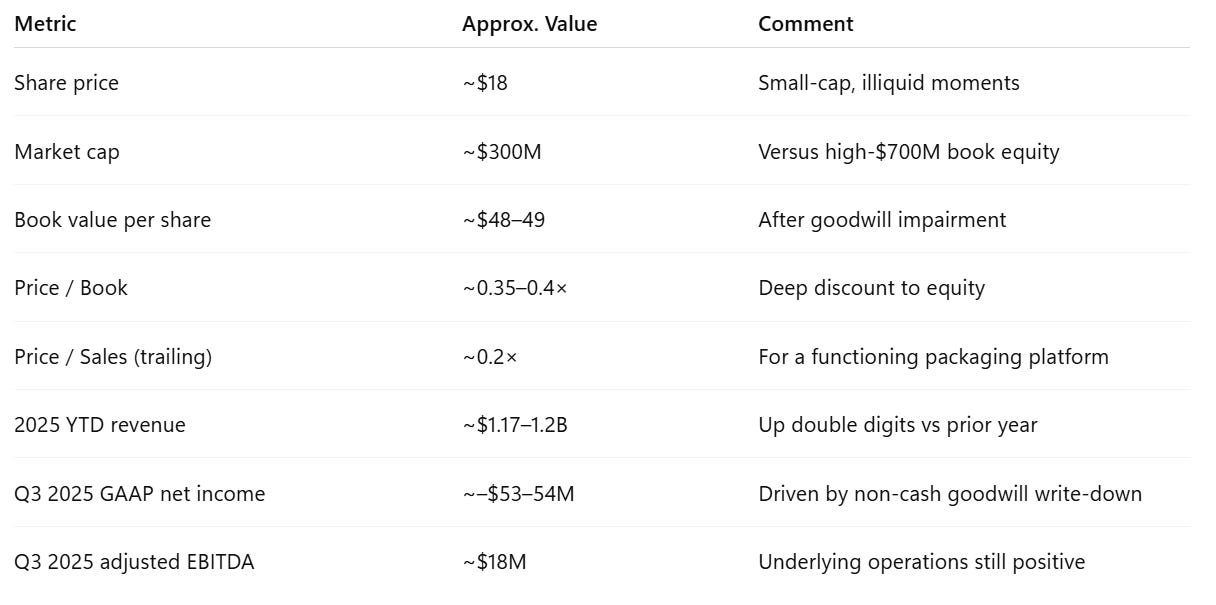
On paper, 2025 looks ugly. Q3 delivered a GAAP net loss of ~$53–54M on about $399M of sales, driven largely by a non-cash goodwill impairment of roughly $45–48M after the share price fell and long-lived asset values were reassessed. Underneath that accounting hit, volumes are higher, revenue is up double digits year-to-date, and adjusted profitability is improving versus 2024.
The market doesn’t care. At around $18 per share, CLW trades at roughly 0.35–0.4× book value and about 0.2× sales, with a market cap near $300M against equity in the high-$700M range.
The question today is not whether Clearwater’s GAAP earnings look good. They don’t.
The question is whether Clearwater’s new paperboard platform + cleaner balance sheet can grind its way to boring, mid-cycle profitability before the market permanently writes it off as a value trap.
If it can earn even 3–4% net margins over the cycle on ~$1.5B of sales, the current price is far too low for a de-levered, asset-heavy platform. If it cannot, you are simply long a shrinking book value story at a discount.
Everything in this 2025 update revolves around three things:
the asset base, the balance sheet, and whether GAAP noise is hiding a survivable, boring business.
Clearwater Snapshot (2025)
What Changed in 2024–2025
Clearwater spent the last 18–24 months completely rewiring itself.
A “transformational” year on paper
Management has accurately called 2024 a “transformational year.” The sequence:
Tissue sale to Sofidel
Gross proceeds: about $1.06B, net roughly $850M after taxes and fees.
Result: exit from a low-return, commoditized tissue segment and a reset of the balance sheet.
Augusta, GA paperboard acquisition
Purchase price: about $700M, based on an expected EBITDA contribution of roughly $100M and network synergies.
Impact: +70–75% increase in paperboard capacity to around 1.4M tons; stronger footprint across North America.
Debt reduction + buyback option
Tissue proceeds used primarily to repay a big chunk of debt, materially improving leverage.
Announced $100M share repurchase authorization, giving the board a clear option if the discount persists.
On the income statement:
2024 net income came in around $196M (≈$11.70 per share), inflated by the gain on the tissue sale but still a clear signal of how much value was crystallised in the transaction.
This is not the same Clearwater you analyzed three years ago. The business you own now is a different machine.
2025: better operations but….ugly GAAP
2025 year-to-date tells the story behind the screens:
Q1 2025
Net sales $378M vs $259M a year earlier (+46%), driven mainly by Augusta volume.
Net loss from continuing operations ≈ –$6M (–$0.36/sh) as integration costs and pricing pressure weighed.
Q2 2025
Net sales $392M vs $344M (+14% YoY).
Net income from continuing operations ≈$4M (≈$0.22/sh) versus a –$42M loss in Q2 2024.
Q3 2025
Net sales $399M vs $393M (flat on paper but with higher shipments).
Adjusted EBITDA around $18M in the quarter.
GAAP net loss ≈$53–54M (–$3.3/sh), driven primarily by a $45–48M goodwill impairment after the share price decline and updated assumptions on long-lived assets.
For the first nine months of 2025:
Net sales ≈$1.17–1.2B vs ~$1.0B a year ago (double-digit growth).
Net loss from continuing operations ≈$56M (–$3.47/sh), mostly explained by the non-cash impairment rather than cash bleed.
Operations are getting bigger and somewhat better. The income statement is getting noisier. The market is reacting to the noise, not the trend.
What Clearwater Paper Owns
Clearwater today is a focused paperboard packaging platform anchored by hard, industrial assets.
Bleached paperboard mills (legacy network)
Long-lived mills producing SBS and related grades for folding cartons, foodservice and packaging.
Embedded infrastructure, rail/road access and utilities that would be extremely expensive to replicate.
Augusta, GA mill (the new engine)
Large SBS mill acquired for about $700M, adding ~70–75% to capacity.
Strategically located in the Southeast, improving freight economics into key converters and brands.
Industrial land and infrastructure
Hundreds of acres tied to mill operations, wastewater systems, energy and logistics infrastructure.
Real optionality around future use, expansions or alternative industrial tenants.
Energy and by-products
Mills generate and sell renewable power, and convert biomass residues, adding a secondary revenue stream and an ESG-friendly profile.
Customer relationships and converting channels
Contracts with packaging converters and branded CPG customers who require consistent, food-grade board, not opportunistic spot tons.
None of these assets disappear because one GAAP quarter looks bad. They are the replacement-cost logic behind Clearwater’s equity story.
🔒 Continue reading: Clearwater’s real valuation, survival odds, and the 2025–2028 roadmap🔒
Below the fold you’ll get:
The updated SOTP (Bear/Base/Bull) for the new paperboard-only CLW
How the tissue sale + Augusta acquisition changed downside risk
The 3 signals that would change our view
Board/management alignment & capital-allocation tells
A realistic 2026–2028 earnings path and book-value math
Our deep-value conclusion and target range
This is where the real work starts.
🔒Upgrade to Fragments Plus to unlock the full Clearwater Deep Value Report.🔒