
DEEP VALUE REPORT — American Vanguard Corporation ($AVD)
Hidden Value in plain sight

The Activists Won the Board. The Recovery Now Belongs to the Lenders.
American Vanguard is the kind of stock that can look mispriced before the investor has reached the bottom half of the balance sheet.
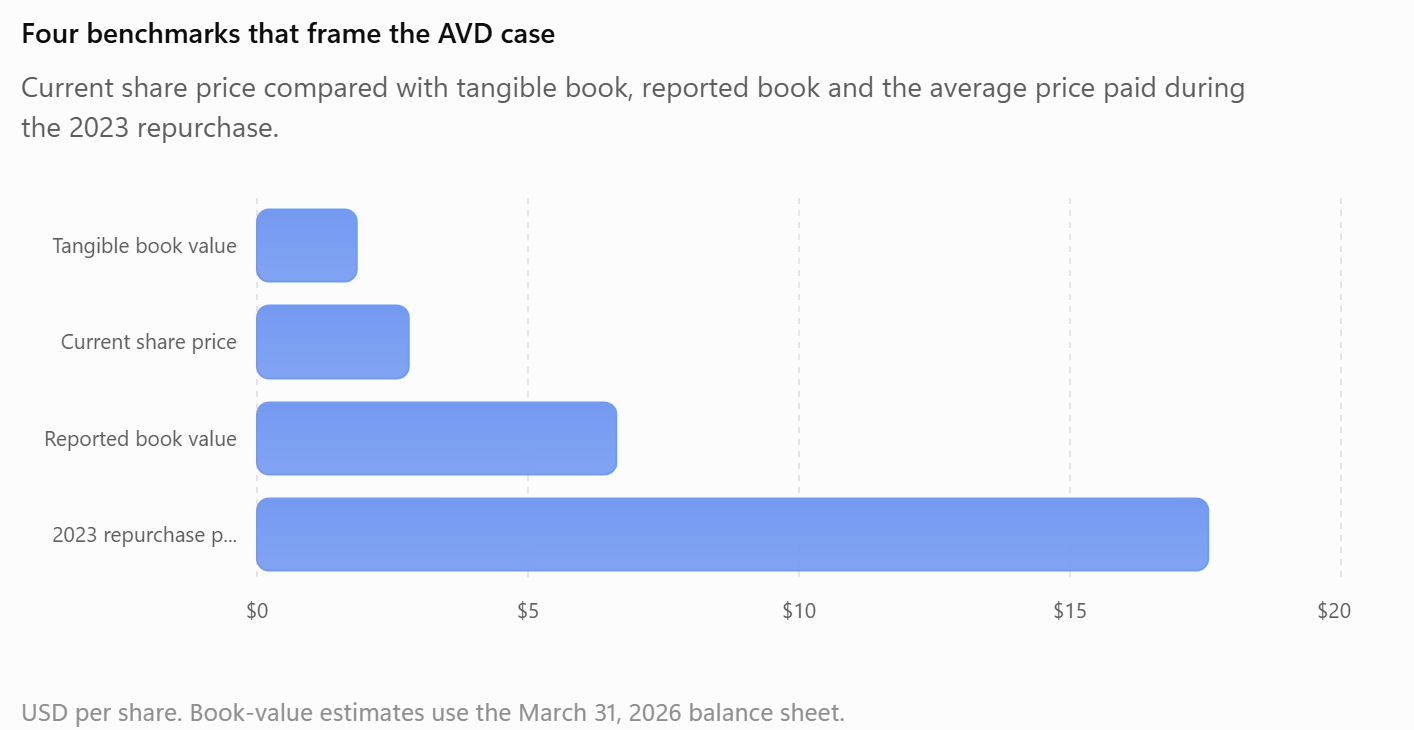
At $2.80, the common equity is worth roughly $80 million. The company reports almost $187 million of receivables, $175 million of inventory, $136 million of identifiable intangible assets and more than 1,000 product registrations. Annual sales still exceed $500 million. Reported book value stands near $6.63 per share.
The picture changes once the financing is included. American Vanguard owes $285 million of contractual principal. After deducting unrestricted cash and adding lease obligations, the operating enterprise is worth roughly $311 million at the current stock price. The resulting valuation is close to 7.9 times 2025 adjusted EBITDA and 6.8 times the midpoint of management’s 2026 guidance.
The assets are substantial. So are the claims ahead of the common shareholder.
AVD is sometimes introduced as a company trading at roughly 42% of book value. That observation is accurate but incomplete. Book value does not show the interest bill, the minimum-cash requirements, the payment-in-kind fee, the tighter future covenants or the influence Centerbridge gained through the March refinancing.
The common stock represents a thin claim on a much larger operating business. A $25 million reduction in debt would add about $0.86 per planning share if enterprise value remained unchanged. A $50 million reduction would add approximately $1.72. A weaker business can remove the same value just as quickly.
American Vanguard has already spent years trying to close the gap between the value recorded on its balance sheet and the cash produced by those assets.
The old management team pursued acquisitions. Cruiser Capital later challenged the board and won three seats. CEO Dak Kaye now wants to improve manufacturing, release working capital, launch more than 50 products, push revenue above $600 million and restore a double-digit EBITDA margin.
Each chapter began with a reasonable idea. The acquisitions were supposed to broaden the portfolio and improve the use of AVD’s factories and registrations. Cruiser expected stronger industrial oversight to restore margins. Kaye is now trying to create growth from products the company already owns or can register without another large acquisition.
The stock price reflects how little patience remains.
Cruiser found the problem before the balance sheet broke
Cruiser Capital’s 2022 campaign began with one striking comparison. American Vanguard’s revenue had increased from approximately $301 million in 2011 to $557 million in 2021. Adjusted EBITDA moved from about $54 million to only $57 million. Revenue had almost doubled while operating profit had barely changed.
Cruiser reconstructed approximately $249 million of acquisition spending between 2014 and 2020. It also estimated that SIMPAS had already absorbed around $30 million without producing a meaningful contribution to gross profit.
The criticism went beyond the size of the acquisition program. Cruiser questioned the returns earned on the purchased assets, the loss of operating margin, the length of several board tenures, the company’s approach to compensation and the amount of equity issued over time. Its proposed operating plan focused on customer engagement, pricing, factory efficiency, asset utilization and a tighter organization.
The three nominees brought relevant experience. Mark Bassett had run Hemlock Semiconductor and managed large Dow businesses. Patrick Gottschalk had led Union Carbide and later Dow’s coatings, monomers and additives operations. Keith Rosenbloom had spent decades investing in special situations and serving on boards, including businesses connected to the chemical industry.
Shareholders elected all three. Gottschalk later became chairman. Bassett joined the Finance Committee. Rosenbloom remained on the board and continued to hold a meaningful personal position.
Cruiser’s diagnosis aged better than its valuation.
The activist believed American Vanguard could move toward EBITDA margins above 15% and support a share price of $55 to $60 by 2025. The forecast assumed that better directors and stronger execution could repair the economics within a few years. The company instead entered 2026 with $285 million of new secured debt, all goodwill written off and the stock below $3.
The old problems were deeper than board composition. Years of acquisitions had created a collection of products, registrations, factories, inventories and customer programs that were difficult to manage as one business. A new board could stop projects and replace executives. It could not immediately turn the accumulated assets into cash.
Cruiser still deserves credit for identifying the capital-allocation failure early. Its intervention has not yet produced a financial return for the shareholders who followed it into the stock.
The strategic review that ended with debt
In June 2025, the board created a temporary Transaction Committee to examine the debt recapitalization and other strategic alternatives. Bassett, Gottschalk and Rosenbloom all served on it. The committee met six times, worked with advisers and became inactive after the March 2026 financing was completed.
The public documents do not say whether buyers submitted preliminary offers, whether individual divisions were discussed or whether the board rejected a price it considered inadequate.
The outcome leaves two plausible readings. Either the offers were insufficient, or the board believed the expensive refinancing preserved more value than selling under pressure. Neither answer is especially comforting. AVD explored alternatives at a difficult moment and chose a loan led by Centerbridge instead of announcing a transaction.
A future sale remains possible. There is no public evidence of an active process today.
Inside the full report: where the acquisition money went, what each part of AVD may be worth, and what needs to happen for the stock to reach $5, $10—or almost zero.
Keep reading with a 7-day free trial
Subscribe to FRAGMENTS to keep reading this post and get 7 days of free access to the full post archives.