
Everybody Is Looking Up
AI needs power. Space needs welders. And the garden still needs water.

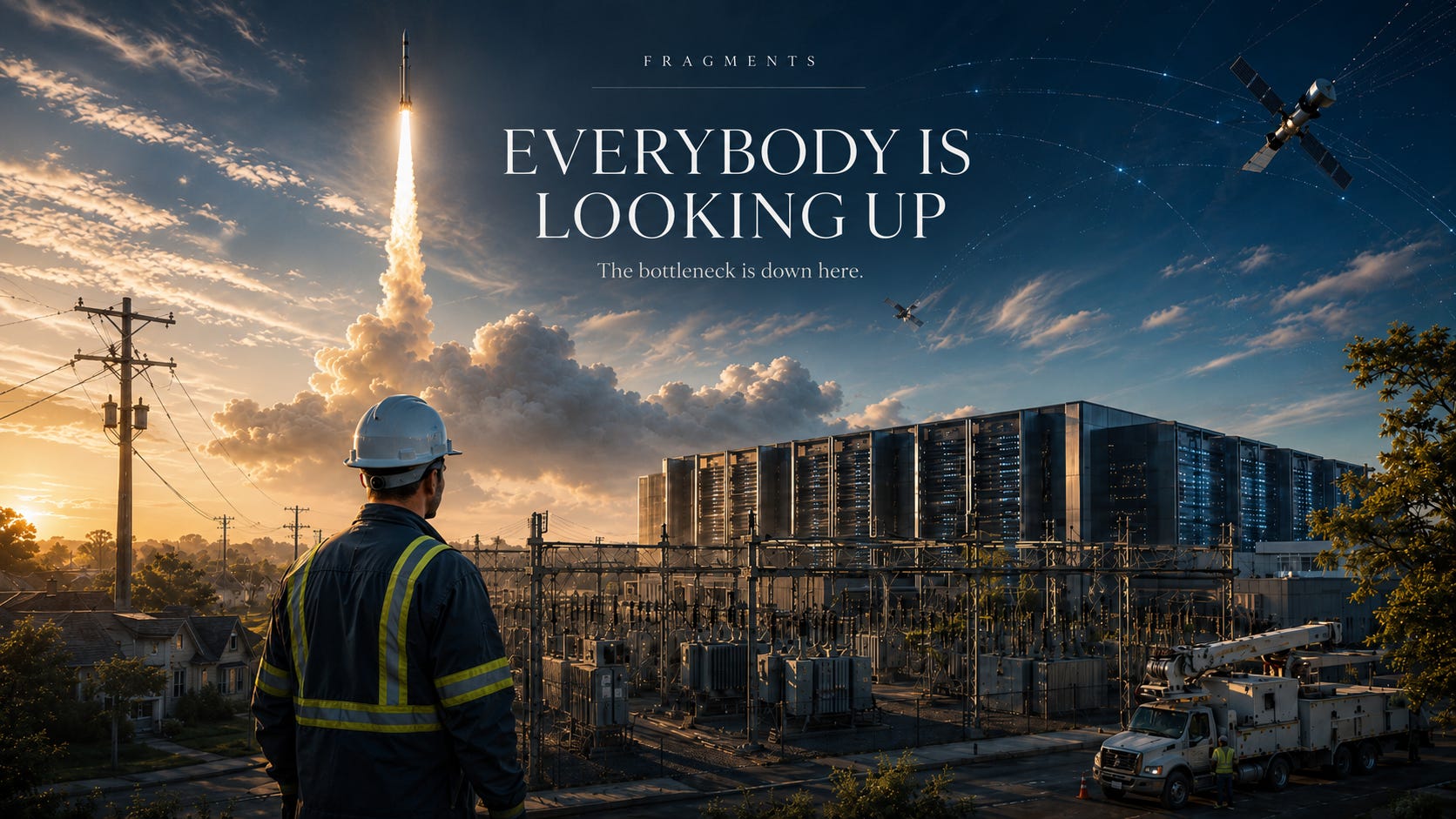
Everybody is looking up.
Rockets, satellites, AI models, data centers, stock charts that look like they forgot what gravity is supposed to do. It is hard not to look. SpaceX just turned the sky into a public-market event: 555,555,555 shares at $135. Not a private-market rumor, not another Musk headline people argue about for two days and forget, but a real offering with a real price attached to it. That kind of number changes the imagination. Suddenly the sky is not just something above us. It becomes something the market can refresh every morning.
Some of that makes sense. Space is not a joke. SpaceX is not a joke. Launch capacity matters. Satellites matter. Communications matter. Defense matters. A country that cannot reach space on its own is not fully independent anymore. The sky is no longer only a dream, a science project, or a billionaire obsession. It is becoming infrastructure.
AI has created another kind of sky. Not above our heads exactly, but above the old economy. Models that write, code, reason, translate, design, summarize, search, automate, and maybe one day absorb work we still think of as safely human. Every month brings a better model. Every quarter brings another data-center plan. Every big tech earnings call now carries the same words: compute, inference, infrastructure, capex, power.
The future keeps getting altitude.
But try booking a plumber.
Try finding an electrician who can come this week. Try renovating a bathroom without waiting. Try getting a haircut for what it used to cost. Try building a house without running into land, labor, permits, materials, financing, utility connections, and the old problem of finding people who actually know how to do the work.
The plumber does not show up faster because the NASDAQ is excited.
That is where the story gets interesting. The economy keeps selling us a future that feels weightless, but the bottlenecks keep getting heavier.
A person can live like that too. He can spend years wanting more. A better job. A better house. Better status. Better life. A better version of himself. There is nothing wrong with wanting more, and there is nothing wrong with wanting better. Ambition is not the problem.
But one day he opens the fridge and there is nothing in it. The garden is dry. The house needs work. The body is tired. The roof has been leaking longer than he wants to admit. The haircut got pushed. The dentist got pushed. The little things got pushed because they were not urgent enough to compete with the dream.
The basics waited quietly in the background until they became expensive.
He was not wrong to want more. He was wrong to forget maintenance.
Economies can do the same thing. They can chase the next frontier and forget the systems that keep the present alive. They can admire the rocket and forget the welder. They can celebrate the model and forget the electrician. They can price the cloud and underprice the grid. Then, one day, the basics stop being cheap. Not because the future was fake, but because the base was neglected.
The cloud still plugs into the wall
The cloud still plugs into the wall. It sounds almost too simple to matter, which is probably why it matters so much.
A model does not float above the economy. It sits in buildings. Those buildings sit on land. The land needs power. The power needs generation, transmission, substations, transformers, cables, cooling, backup systems, permits, maintenance, water, security, and people. A prompt feels weightless to the person typing it. It is not weightless to the grid.
In 2025, electricity demand from data centers rose 17%, while global electricity demand rose around 3%. AI-focused data centers climbed even faster. That is the physical sentence underneath the AI sentence. The interface is software. The factory is not.
For years, investors were trained to love asset-light businesses. High margins. Low incremental cost. Global distribution. Code moving through the world with almost no friction. That was real, and it created enormous value. But AI keeps the magic of software at the surface and brings back the weight of industry underneath.
Data centers are not websites with better branding. They are industrial assets. They consume land, power, water, metals, cooling equipment, backup systems, and skilled labor. They pull on utilities, natural gas, nuclear, renewables, transmission, copper, aluminum, steel, cement, transformers, turbines, generators, and workers who know what happens when a system is overloaded.
The digital economy is not replacing the ground. It is demanding more from it.
That changes the question. The easy question is whether AI keeps improving. It probably does. The easy question is whether people keep using it. They probably do. The harder questions are lower down. Who powers it? Who builds it? Who connects it? Who cools it? Who maintains it? Who finds the workers? Who gets the permits? Who pays for the grid?
Scarcity is not always where the story is loudest. Sometimes it is buried in the boring parts that must work before the exciting parts can scale.
The more the economy looks up, the more valuable the ground becomes.
The old world did not leave
A haircut is a small thing, and that is why it is useful. It is not a platform, a model, a token, or a cloud service. It is one person standing behind another person with scissors. It does not scale well. It cannot be shipped from another country. It cannot be downloaded. It cannot be automated without making the customer uncomfortable. It takes rent, time, skill, trust, and local demand.
So the price goes up.
The same thing is happening all over the physical economy. Plumbing. Electrical work. HVAC. Roofing. Mechanics. Construction. The quiet work that lets the rest of the economy pretend it has become modern.
For a long time, prestige moved away from that world. Parents wanted university degrees, not trade schools. Companies wanted coders, not welders. Capital wanted platforms, not maintenance. Cities wanted innovation districts, not zoning fights. Markets wanted the next frontier, not the old foundation.
Then AI arrives and the richest companies in the world need electricians.
Google is putting $50 million behind training 300,000 skilled-trade workers. Meta is putting $115 million into America’s Workforce Academy, a no-cost skilled-trades program tied directly to the infrastructure buildout. Welders, plumbers, electricians, fiber technicians. Microsoft is moving with the building trades too, not to turn every apprentice into a software engineer, but because the person installing electrical systems inside a data center now sits directly under the AI boom.
That is the part of this cycle that feels least like a boom and most like reality. The model gets the headline. The worker gets the building open.
Space works the same way. A rocket points upward, but the business is built on the ground: fuel, heat, metal, vibration, welding, engines, valves, pumps, composites, launch pads, ground systems, testing, failure, retesting, weather, range safety, suppliers, government contracts, capital intensity, people. Space is futuristic because it is brutally physical.
That is why the SpaceX moment is interesting. Not because rockets are ridiculous. They are not. SpaceX is a real industrial achievement, and dismissing rockets misses the point. The better question is what happens after the market falls in love with a frontier.
At first, a frontier looks clean. There is a leader. There is a story. There is a giant market. There is a feeling that the old rules have become too small. Capital arrives. Competition follows. The clean story gets dirtier.
Electric vehicles already went through this. The product was real. The adoption was real. The leader was real. Then everybody wanted in. Capital poured into batteries, factories, supply chains, charging, mining, platforms, software, and brands. Eventually the industry became an industry. Prices moved. Margins got tested. Lithium-ion battery-pack prices fell 20% in 2024, helped by lower mineral prices and competition, especially in China.
The dream did not disappear. The dream became competitive.
AI may go through its own version of that. Space may too. The leader can be real and the industry can still become crowded. The technology can matter and the average investment can still disappoint. A market can grow and returns can still compress when too much capital chases the same horizon.
That is what people forget when they look up. They see the altitude. They do not see the crowd climbing behind them.
A frontier is beautiful before the competition arrives. After that, it becomes an industry. And industries eventually remember their costs.
The base starts collecting rent
When capital chases a new thing, the first attention goes to the obvious names: the rocket company, the AI lab, the chip company, the model provider, the platform, the ticker everybody knows. That is natural. The leader is visible. The story is simple. The excitement has a center.
Second-order effects often move somewhere else.
A more digital economy needs more electricity. A more electric economy needs more grid. More grid needs copper, aluminum, transformers, poles, substations, engineers, linemen, land, permits, and time. More data centers need cooling. More cooling needs water, air, equipment, maintenance, and power. More rockets need better manufacturing. Better manufacturing needs machine tools, skilled labor, quality control, suppliers, and discipline.
The dream gets cleaner at the top. The constraint gets dirtier at the bottom.
That is where the base starts collecting rent. A data center that cannot get power is just a building with expensive plans. A rocket company without manufacturing discipline is ambition with a launch date. A grid without transformers is a promise waiting on hardware. A city without trades is a housing shortage with nicer renderings.
The old world does not disappear because the new world gets exciting. It becomes the bottleneck.
Critical minerals sit in the same story: lithium, nickel, cobalt, graphite, rare earths, copper. These are not abstract themes. They sit inside batteries, grids, motors, electronics, transmission, and industrial equipment. The IEA says recent demand growth has been driven by energy uses such as EVs, battery storage, renewables and grid networks; in copper, grid investment in China has been the single largest contributor to demand growth over the last two years.
But even here, the lesson is not simple. A commodity can be essential and still be a bad investment at the wrong price. A utility can be necessary and still destroy value. A construction supplier can benefit from demand and still get crushed by cycle timing. A skilled-labor shortage can be real and still not flow cleanly into public-market returns.
There is no free money just because the theme is right.
The lesson is colder than that. When everyone prices the frontier, look at what the frontier consumes. Look at what it needs before it can grow. Look at what cannot scale quickly. Look at what no one trained for. Look at what cannot be imported, coded, automated, or financed overnight.
That is where the neglected economy starts to matter again.
Where deep value may hide
This is where the story becomes more than a technology story.
The obvious trade is always at the top. The rocket company. The AI lab. The chip winner. The model everyone uses. The platform. The stock everybody can name. That is where the narrative goes first, and sometimes the narrative is right.
But deep value usually does not live where everyone is already staring.
It hides in the bottleneck.
Not every bottleneck is a good investment. A company can be essential and still be badly run. A commodity can be needed and still be overpriced. A utility can sit in the middle of the future and still earn mediocre returns for shareholders. The theme alone is not enough.
But the question is useful.
What does the dream need that the market still treats like yesterday’s business?
The AI boom needs power. That means the grid matters again. Data centers need cooling, land, backup systems, transformers, maintenance, water, and people who can build and fix things. Space needs manufacturing, welding, testing, precision suppliers, launch infrastructure, and industrial discipline. The more capital runs toward the visible frontier, the more important the hidden base becomes.
That is where a certain kind of deep value can appear. Not in the loudest stock. Not in the cleanest story. In the boring company whose assets, workforce, permits, location, equipment, customer relationships, or replacement cost suddenly matter more than the market thought.
The old economy does not have to become exciting.
It only has to become scarce.
And scarcity has a way of changing the math.
Deep value often begins where the market confuses boring with obsolete.
If this way of reading markets makes sense to you — not chasing the dream, but studying what the dream consumes — the next paid FRAGMENTS report goes one level deeper into the bottleneck.
Maintenance does not introduce itself as growth
Nobody wants to talk about maintenance when the frontier is moving. Maintenance feels defensive. It feels like repainting the fence while everyone else is building rockets.
But maintenance is not the opposite of progress. It is what allows progress to survive.
A road is maintenance. A bridge is maintenance. A power line is maintenance. A water system is maintenance. A trained workforce is maintenance. A house that does not fall apart is maintenance. A grid that can accept new load is maintenance. A body that can keep working is maintenance. A garden that is watered before it dies is maintenance.
Markets often underprice maintenance because maintenance does not introduce itself as growth. It shows up as cost, delay, capex, compliance, permits, and a person in a reflective vest saying the project cannot move until the boring thing is fixed.
So it gets pushed. Then the price comes back all at once.
The bridge needs more than a patch. The grid needs more than an upgrade. The house needs more than paint. The shortage needs more than a recruiting campaign. The trade-school pipeline needs more than a speech. The housing market needs more than a rate cut. The AI boom needs more than chips.
It needs the old world.
This is not a political point. It is not anti-rich. It is not anti-tech. It is not a complaint about ambition. Private capital behaves like private capital. It seeks scale, return, speed, control, and stories it can understand. A rocket company with a dominant position, government demand, satellite revenue, and a giant strategic narrative is easier to love than a municipal water system. An AI model is easier to hype than a transmission line. A launch is easier to film than a substation upgrade.
The market is not stupid for liking the sky. The sky has a narrative. The ground has a schedule delay.
Somewhere inside that trade is where future value may be found. Not automatically. Not neatly. Not because every boring company is suddenly wonderful. Some will be expensive. Some will be cyclical traps. Some will be badly run. Some will raise capital at the wrong time. Some will benefit from demand and still never produce much for shareholders.
But the question is right.
If everyone is looking up, what is being neglected underneath?
The competition for the next thing
There is another human version of this.
A man spends years chasing the next thing. Better work, better life, better status, better everything. After a while he looks around and realizes he is not the only one chasing it. Everybody else saw the same thing. Everybody else wanted the same prize. The new thing is no longer new. The room is crowded. The easy advantage is gone.
That is when the neglected basics start to look different. Food. Sleep. Health. Home. Work that actually compounds. The quiet systems he thought he could ignore because they were not exciting enough.
The economy does the same thing. A new frontier attracts people, then capital, then competition, then overbuilding, then price cuts, then weaker players, then a shakeout. Railroads. Telecom. Solar. Shale. Streaming. EVs. It can happen in AI. It can happen in space.
A boom does not have to be fake to hurt investors. Sometimes the most painful booms are built around real technologies, because reality gives the story credibility, and credibility attracts too much capital.
The internet was real. Many internet stocks were not worth what people paid. EVs are real. A lot of EV capital was badly treated. AI is real. Some AI economics will be competed away. Space is real. Some space returns will be fought over by companies, governments, suppliers, and capital markets.
That does not mean the frontier should be ignored. It means altitude is not enough.
The useful question is not only: what is the next thing?
It is: what does the next thing make scarce?
Power. Grid. Cooling. Copper. Transformers. Land. Permits. Industrial capacity. Skilled labor. Maintenance. Local services. The things that do not sound like the future until the future cannot move without them.
The boring constraint returns
The modern economy spent years trying to escape constraints. Software escaped shelves. Media escaped paper. Retail escaped stores. Work escaped offices. Money escaped branches. Entertainment escaped schedules. Information escaped libraries.
That was real progress. It made life better in many ways. It created huge companies and huge efficiencies.
But not every constraint disappears. Some only move.
The constraint used to be distribution. The internet changed that. Access to information used to be the constraint. Search changed that. Compute used to be the constraint. Cloud changed that.
Now the constraint is becoming power, heat, land, water, materials, permits, skilled labor, and time.
The boring things.
The things the future was supposed to make less important.
There is a kind of economic justice in that. The real world has a way of collecting rent from anyone who treats it as optional. You can build the smartest model in the world and still need a transformer. You can raise the biggest space offering in history and still need welders. You can talk about autonomous systems and still need someone to repair the roof. You can live in the cloud and still call a plumber when the basement floods.
That is why the plumber belongs in the same article as SpaceX and AI. Not because plumbing is more important than AI. That is the wrong comparison. The plumber matters because he represents the part of the economy that cannot be abstracted away: local work, physical work, trust work, skilled work, maintenance work. The work that looks small until it is missing.
A society that looks down on that work long enough eventually pays more for it. Not because of nostalgia. Because supply and demand still works. If fewer people learn the trade, the trade becomes scarce. If the work cannot be imported easily, local pricing power returns. If the asset cannot be replaced quickly, maintenance becomes leverage. If the grid cannot expand fast enough, power becomes strategic. If data centers need more electricity than expected, utilities and regulators matter again. If AI needs a physical buildout, the old economy gets pulled into the new one.
That is not culture war. That is market structure.
There is a gap between what markets like to price and what life needs to function. Markets like clean stories. Life needs messy systems. Markets like scale. Life needs local capacity. Markets like asset-light. Life needs heavy assets. Markets like optionality. Life needs reliability. Markets like the next thing. Life needs the thing that still works when the next thing breaks.
The gap has always existed. It feels wider now because the stories are bigger. AI is not a normal product cycle. Space is not a normal industry. Data centers are not small office buildings with servers in them. The capital numbers are huge. The valuations are huge. The ambitions are huge.
So the base has to get huge too.
That is the part nobody likes to sit with. It is easier to imagine a machine thinking than a decade of grid work. It is easier to imagine rockets landing than enough workers being trained to wire the next generation of infrastructure. It is easier to imagine a future in orbit than fixing zoning, housing, water, power, roads, and permitting on the ground.
The frontier is dramatic. Maintenance is humble. But humble is not the same as irrelevant.
The garden still needs water.
That line sounds soft. It is not. A garden does not care about ambition. It does not care how good the plan is, how much money was raised, how many people believed the story, or how many times someone said the future would be different. If it is not watered, it dies.
Infrastructure works the same way. Skills work the same way. Housing works the same way. Electricity works the same way. Industrial capacity works the same way. Ignore them long enough and they do not disappear. They become bottlenecks. Then they become inflation. Then they become political problems. Then they become investment themes. Then everyone suddenly discovers they were important.
The wrong lesson is to stop looking up. Looking up is part of being human. Curiosity built civilization. Ambition built markets. Space matters. AI matters. Satellites matter. Data centers matter. The companies building these systems are not automatically bubbles because they are expensive, and they are not automatically bad because they are ambitious.
The other wrong lesson is that boring things automatically make good investments. They do not. A business can be essential and still be badly run. A company can own important assets and still destroy capital. A utility can be necessary and still be overpriced. A materials company can have demand behind it and still get crushed by timing. A skilled-trades shortage can be real and still not translate cleanly into public-market returns.
Reality does not hand out returns because a thesis sounds right.
The better lesson is simpler. When everyone is looking up, spend more time looking down. Look at what the frontier consumes. Look at what it depends on. Look at what competition will do after capital floods in. Look at what cannot scale fast enough. Look at what nobody trained for. Look at what cannot be shipped, coded, automated, or financed overnight. Look at what was treated as boring for twenty years and is now becoming scarce.
The future rarely replaces the past as cleanly as people expect. It sits on top of it. It pressures it. It exposes it. It pulls demand through it. It makes the weak parts visible.
AI does not erase electricity. It increases the need for it. Space does not erase manufacturing. It demands better manufacturing. Cloud does not erase land. It needs more of it in the right places. Digital does not erase labor. It changes which labor becomes scarce.
The frontier does not float.
It rests on the base.
Maybe that is the story now. Not that people are wrong to look up, but that we have spent so long admiring altitude that we forgot to check the foundation.
The roof still leaks. The garden still needs water. The haircut still costs fifty bucks. The plumber is still busy. The grid still has to carry the load. The rocket still needs welders. The cloud still plugs into the wall.
Everybody is looking up.
The bottleneck is down here.
Next for paid subscribers: Where the Bottleneck Hides.
A deeper FRAGMENTS report on the physical base behind AI and space: power, grid, cooling, copper, transformers, skilled labor, maintenance, and the old companies the market still treats like yesterday’s business
I enjoyed this. I started thinking, while I was reading, about how the underlying support systems often operate on a very different clock than the frontier industries they enable.
AI, space, and other emerging sectors are driven by opportunity, excitement, and the desire to get positioned early. But power systems, skilled labor, permitting, manufacturing capacity, and infrastructure tend to move at the pace of the physical world.
That timing mismatch may be part of why bottlenecks emerge. The frontier can accelerate much faster than the foundations beneath it can expand.