
FRAGMENTS — SHADOW BUILDER — MARS, INC. Inside a $50B Private Operating Machine
Hidden Value in plain sight


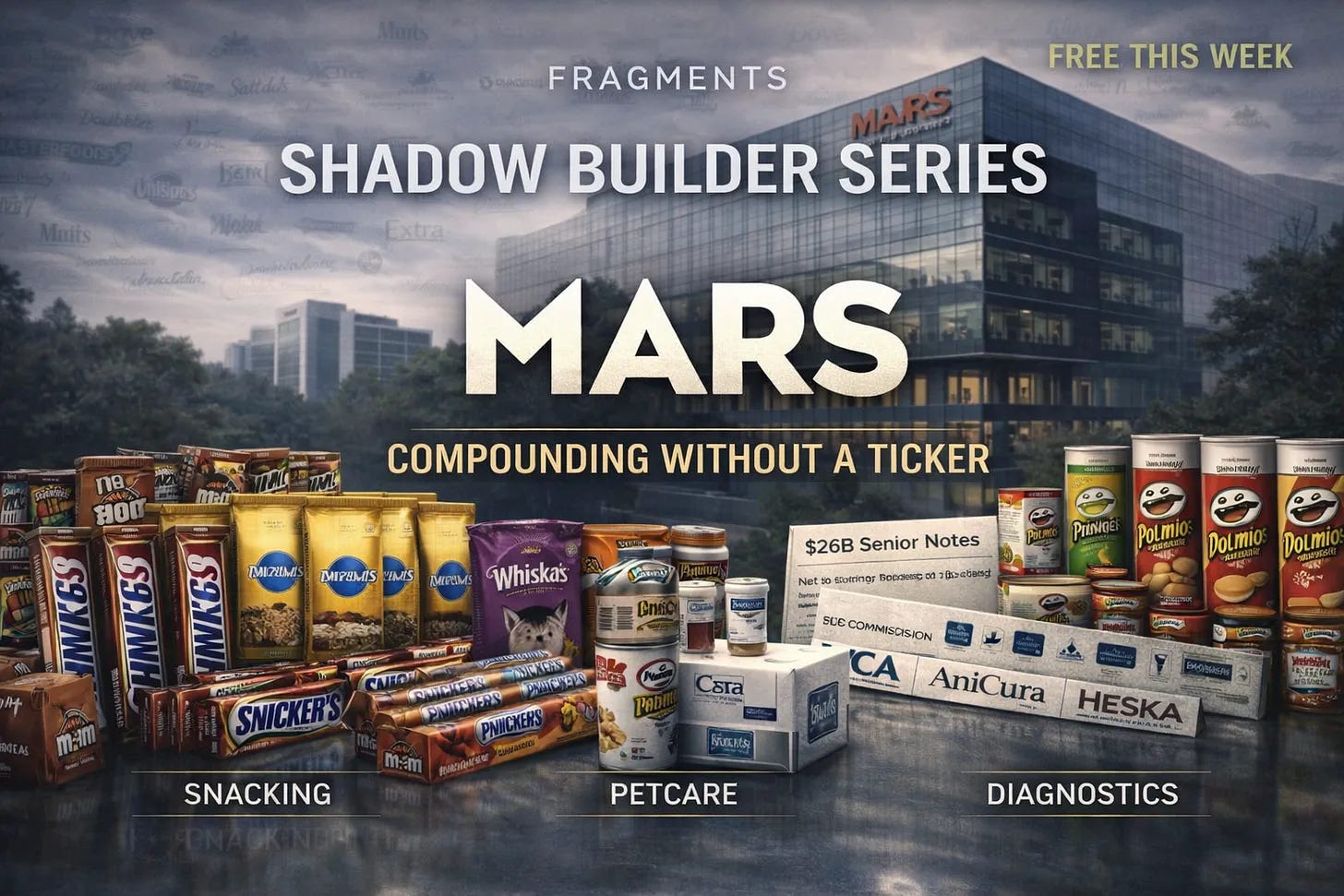
This Shadow Builder file is published free this week, as a reference case for how private operating empires are built.
A private empire that doesn’t publish earnings… yet still leaves enough receipts to rebuild the operating file.
Mars is one of the few modern companies that can buy a public company outright, finance it with institutional debt, clear regulators across continents, and still keep its operating reality mostly private.
Most Mars writing isn’t wrong — it’s just soft. It’s the same film: family-owned, iconic brands, “secretive,” pet humanization, values, culture.
That’s a profile.
This is a Shadow Builder file — built from what private empires can’t fully hide: founding and control lineage, named leadership, acquisition tape, regulator language, and the moments the credit market forces disclosure.
If you want to understand how a privately controlled operating empire compounds in 2026 — and why it can buy a ~$36B public company without ever “going public” — Mars is the cleanest living example.
1) The origin story
Mars began as a small candy business built by Frank C. Mars. Mars’ own corporate history highlights the first scalable breakthrough: Milky Way (1923), created after a discussion between Frank and his son Forrest Mars Sr. about turning a “malted milk” idea into a candy bar that could be manufactured and distributed at scale.
That father–son detail matters because it captures the Mars DNA in one scene:
Product is the artifact. Manufacturing + distribution is the engine.
From there, Mars expands by replicating capability — not just brands. The early pattern is simple and durable: own the machine end-to-end (procurement, footprint, distribution leverage), keep control private, reinvest without public-market theatre.
2) Org + Control: who owns, who runs, and where power sits
Mars is described in forced-disclosure reporting as a fifth-generation family business.
That line matters, but not because it’s sentimental. It matters because it explains the operating behavior: long horizon + private control + capital allocation discipline.
The key point is this: family-owned does not mean family-operated day-to-day.
Mars has a named operator at the top: Poul Weihrauch, CEO and Office of the President since September 2022 (Mars states this directly).
So the structure is:
Owners (family): control and governance; long horizon; payout decisions; acquisition appetite.
Operators (management): integration; footprint; execution; the “quiet compounding.”
This is why Mars can do what public companies struggle to do: take big swings (Wrigley, VCA, AniCura, Kellanova), integrate without quarterly narrative management, and keep strategy coherent across decades.
3) How much money do they make? The hard answer, the honest limits
Revenue (provable)
Mars is private, so you don’t get 10-Ks. But you do get receipts when financing is involved.
A prospectus obtained and reported in Bloomberg Law showed Mars had $54.6B in net sales in 2024, up 4.6% from a year earlier.
Mars itself, in its Kellanova deal announcement, stated 2023 net sales of more than $50B.
So the scale is not a guess: Mars is a $50B+ revenue private operator.
Profit (not published like a public company, so we won’t fake it)
You asked for profits. The truthful answer: Mars does not publish GAAP net income publicly like a listed company.
But Mars still leaves forced economic tells that matter more than people admit:
Bloomberg Law reporting from the prospectus said Mars paid $1.5B in dividends to family shareholders in 2024.
Reuters reported Mars announced an eight-part investment-grade bond offering to finance Kellanova, expected to raise $25–$30B, with maturities ranging two to 40 years, and a commitment to redeem at a premium if the acquisition doesn’t close by Aug. 20, 2026.
Mars’ own release confirms it priced $26B of senior notes with maturities spanning 2027 to 2065.
A private company doesn’t distribute $1.5B to owners and place $26B of long-dated acquisition financing on “brand vibes.”
Operator translation: you may not see the net income line, but the market behavior proves a reality: big, durable cash generation.
4) Divisions: what Mars says vs. what Mars built
Mars frames itself across Snacking, Petcare, and Food in official communications.
The Shadow Builder read is not the label. It’s what Mars bought inside each label — and what that did to the economic quality of the empire.
A) Snacking: portfolio density and retailer leverage
Mars agreed to acquire Kellanova for $83.50 per share, total enterprise value $35.9B.
Regulators told you why this mattered. The European Commission opened an in-depth investigation citing preliminary concerns that the deal could lead to higher prices due to Mars’ increased negotiating power toward retailers in the EEA.
Then the EU later approved the deal after investigation.
And Mars states the transaction received all required regulatory approvals as of December 8, 2025, and closed December 11, 2025.
The point: this is not “Mars adds snacks.” This is Mars increases shelf power — category breadth, must-carry density, negotiation weight.
B) Petcare: not “pet food” , an embedded services + diagnostics platform
This is the biggest misread in most Mars coverage. People stop at “pets are family.” Mars built an infrastructure layer.
Here is the cleanest receipt: Heska.
Mars completed the Heska acquisition on June 13, 2023, at $120.00 per share, and stated plainly: Heska is now part of Mars Petcare’s Science & Diagnostics division.
That’s not a vibe. That’s an internal operating placement.
Now add the VCA and AniCura tape and you can see the architecture:
VCA: Mars agreed to acquire VCA for $93 per share, total value about $9.1B including debt — a move into scaled veterinary services.
AniCura: Mars Petcare signed to acquire AniCura (June 2018), then completed the acquisition in November 2018 (with EU antitrust clearance subject to divestiture of VetFamily).
So Petcare is not one business. It’s three, stacked:
Layer 1: Products (Pet Nutrition)
Large and visible. Also the least interesting part of the “why Mars is durable” story.
Layer 2: Services (Veterinary clinics and care networks)
This is where spend becomes more embedded and recurring — less promotional, more workflow.
Layer 3: Diagnostics / Science
Heska is explicitly placed here. Diagnostics ties the ecosystem together: clinics need it; workflows depend on it; tech gets embedded.
Operator translation: Mars didn’t just ride “pet humanization.” Mars built a pet healthcare machine where spend is attached to workflow and care — the opposite of a seasonal candy narrative.
C) Food: stabilizer and throughput
Food doesn’t headline, but it stabilizes. It’s footprint utilization, procurement leverage, and scale discipline — the unsexy part that lets the empire survive cycles.
5) The deal tape: the moves that changed Mars’ economic quality
This is where Shadow Builder lives: what got bought, what it changed, why it matters.
Wrigley (2008): the private-company template at scale
Reuters reported Mars and Berkshire buying Wrigley for $23B, creating a larger confectionery player.
Later Reuters reported Mars buying out Berkshire’s minority stake in Wrigley to take full control.
This matters because it shows the pattern early: private control enables big moves that might be hard to justify quarter-by-quarter.
VCA (2017): services scale inside Petcare
Terms are explicit: $93/share, about $9.1B including debt.
This was Mars converting Petcare from products into services infrastructure.
AniCura (2018): European clinic footprint
Mars describes this as a strategic entry into European veterinary care, and later announces completion with EU clearance and divestiture condition.
Heska (2023): diagnostics becomes internal infrastructure
Heska is folded into Science & Diagnostics.
Kellanova (2024–2025): mega portfolio + institutional financing
Deal terms are explicit in the SEC exhibit and Mars release: $83.50/share, enterprise value $35.9B.
EU investigates based on retailer negotiating power; later clears.
Mars finances with $26B notes; Reuters describes the broader bond structure and fail-to-close redemption mechanics.
6) Kellanova in 10 lines: why Mars did this deal
Mars bought Kellanova because it increases portfolio density where density creates bargaining power.
It adds must-carry brands across multiple consumption moments, not just candy.
That breadth changes retailer negotiations: more categories, more shelf real estate, more trade leverage.
Regulators explicitly worried that this increased negotiating power could lead to higher prices in the EEA.
Mars didn’t need the deal for “growth storytelling.” It needed it for terrain.
The financing confirms intent: long-dated institutional debt, not a delicate balance-sheet stunt.
And when the EU clears after full investigation, that becomes another receipt: Mars can operate at global scale and survive deep regulatory scrutiny.
This is a control business buying more control.
7) One-page timeline
1911–1923: Frank Mars builds the early machine; Milky Way scales in 1923 from the Frank–Forrest discussion.
2008: Mars + Berkshire buy Wrigley for $23B.
2016: Mars buys out Berkshire’s Wrigley stake for full control.
2017: Mars agrees to acquire VCA for $93/share (~$9.1B incl. debt).
2018: Mars acquires AniCura; EU clearance includes a divestiture condition; completion announced Nov 2018.
2022: Poul Weihrauch becomes CEO (Office of the President).
2023: Heska completed; folded into Petcare’s Science & Diagnostics.
2024: Mars announces Kellanova deal ($83.50/share; $35.9B EV).
2025: EU opens in-depth probe (retailer leverage / price concerns).
2025: Mars prices $26B senior notes for Kellanova.
Dec 2025: Regulatory approvals complete; deal closes Dec 11.
8) Risks / What breaks it
Mars is not “fragile,” but it is not invincible. The risks are operational, not philosophical.
Integration risk (real):
Kellanova is large. Portfolio integration creates hidden complexity: procurement, distribution, SKU rationalization, retailer negotiations, brand overlap, and organizational load.
Regulatory/behavioral constraints:
Even after clearance, the process itself is a receipt: regulators focused on retailer leverage and price effects. That tells you the “watch area” for Mars’ snacking strategy in Europe is not product quality — it’s market power perception.
Debt discipline becomes a visible constraint:
$26B of notes with maturities out to 2065 is a statement of strength, but also a constraint: rating pressure, refinancing windows, and a need for cashflow stability through cycles.
Petcare cost inflation / labor:
Services businesses can face wage/labor pressure and capacity constraints; diagnostics can see pricing and utilization cycles tied to clinic volumes. Mars has built durability here — but that’s where operational friction would show up first.
Reputation / pricing optics in a high-inflation world:
Mars is big enough that “pricing behavior” becomes a political and regulatory narrative. The EU probe language is a receipt of that risk.
Conclusion: Mars doesn’t sell candy, Mars sells permanence
If you only look at Mars as “brands,” you miss the machine.
Mars is a privately controlled operating empire that learned early how to scale: build manufacturing and distribution advantage, keep control inside the family, reinvest without quarterly performance theatre, and use capital allocation to buy other machines.
The last few years made that reality unavoidable:
Petcare isn’t just food; it’s clinics and diagnostics, with Heska explicitly folded into Science & Diagnostics.
Snacking isn’t just growth; it’s portfolio density and retailer leverage, with regulators explicitly describing the concern in plain language.
And the financing is institutional scale: billions paid to owners, tens of billions raised for acquisitions, maturities spanning decades.
Mars doesn’t need the market’s approval to compound.
That’s the Shadow Builder lesson:
the most powerful capital allocators don’t always trade — but they set the rules of the categories that do.
Why FRAGMENTS exists
Most of what matters in markets happens outside earnings calls and headlines.
FRAGMENTS focuses on structure, control, capital allocation, and the private empires that quietly shape public markets.If this Mars case file changed how you look at power and compounding, you’ll find the same operator lens across every piece.
→ Subscribe to FRAGMENTS