
RECTOMYOPIA
When Every Financial Data Point Looks Like Shit

RECTOMYOPIA
When Every Financial Data Point Looks Like Shit
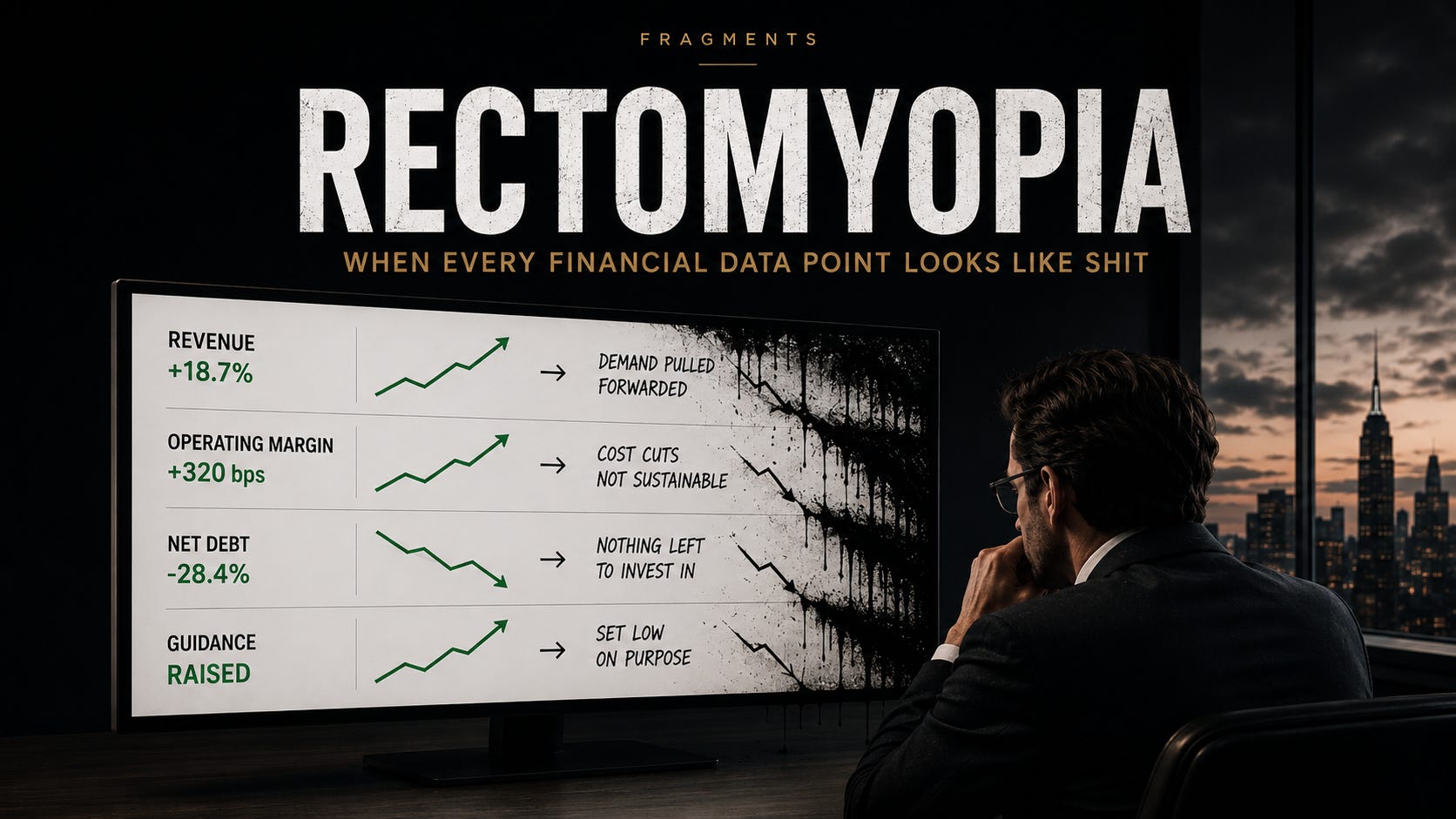
A company reports a good quarter. Revenue is up, so demand was probably pulled forward. Margins improved, which means management must be cutting too deeply. Debt came down because there was apparently nothing useful left to invest in. Guidance was raised, proving the original guidance had been set low on purpose. The stock jumps 12% and investors have lost their minds. It gives back 4% the following week and the market is finally waking up.
After a while, you start wondering what management could possibly report that would make the investor less negative.
More capital spending means cash burn. Less capital spending means the company is starving the business. Holding cash shows a lack of imagination. Spending it shows a lack of discipline. Buying back shares flatters earnings per share. Stopping the buybacks means insiders know the stock is overpriced. Higher prices will drive customers away. Lower prices prove the company has lost pricing power. Buy a competitor and the core business must be weak. Sell a division and they are selling the furniture to pay the electric bill.
Any one of those explanations may be right. The trouble starts when every opposite result proves the same conclusion.
Rectomyopia is the inability to look at a financial number, a management decision or an economic development without seeing shit.
The person suffering from it rarely sounds irrational. He reads annual reports, checks the footnotes, studies the debt maturities and distrusts every adjusted number management puts near the front of the presentation. He knows how working capital can flatter cash flow. He understands dilution, cyclicality, pension obligations and refinancing risk. He has watched enough management teams move expenses around to know that a clean quarter can have dirty plumbing.
Those are good habits. Markets have taken plenty of money from people who lacked them.
The problem begins when skepticism stops testing an opinion and starts protecting it. The company refinances its debt and the lenders have merely postponed the funeral. It fails to refinance and the funeral is back on schedule. Free cash flow improves and working capital must be hiding something. Working capital normalizes and management probably stretched its suppliers. Customer retention stabilizes, but only because prices were cut. Prices hold up, so customers will eventually leave.
The company could cure cancer and someone would ask what happened to receivables.
A refinancing can genuinely push a larger problem into the future. Better cash flow can come from paying bills later. Cost reductions can damage the business. Management teams lie. Weak companies often survive several years longer than they deserve to.
A serious investor should question an improvement when the numbers underneath it look weak. A serious short seller should know when a company bought itself another quarter without repairing anything.
Rectomyopia begins when no improvement, at any price, could make the investor even slightly less negative.
The company can be terrible. The stock can still be cheap.
Once a business enters the mental category marked broken, the share price starts disappearing from the discussion. The stock falls from $40 to $20, then to $8 and eventually to $2. The same list of problems gets repeated at every level, usually with more confidence because the falling price feels like proof.
The problems remain. The investment has changed.
At $40, the market may have expected a recovery. At $20, it may have expected years of stagnation. At $8, a severe decline. At $2, the company may be priced as though the ending has already been written.
A business priced for extinction does not need to become wonderful. It may only need to remain alive.
One refinancing can change what the equity is worth. So can an asset sale, a competitor shutting down, a modest recovery in margins or a quarter in which the situation simply stops getting worse. The company can remain heavily indebted, badly managed and stuck in an ugly industry while the shares rise because reality turned out slightly less awful than the price assumed.
The rectomyopic investor sees every weakness in the company and misses the price of those weaknesses. Revenue can decline exactly as expected. Management can remain mediocre. The balance sheet can stay uncomfortable. None of it guarantees a profitable short if the market had already priced something worse.
Finance regularly allows someone to be right about the company and wrong about the stock.
Deep value is full of situations where almost everyone agrees on what is broken. The real argument sits somewhere else. How much time does the company have? What can it sell? Will the lenders extend the maturities? Who controls the board? Can a competitor leave the market? Could an activist force a change? What remains for shareholders if the business survives without ever becoming great?
The rectomyopic investor often stops before those questions. He has already found enough problems to reject the company.
Walking away feels prudent. Sometimes it is. Other times, the stock has already been priced for a disaster much worse than the one likely to arrive.
The same mistake works in reverse. A wonderful company becomes a terrible investment when its share price assumes perfect execution for years. Strong management, a clean balance sheet and beautiful margins cannot save an investor who paid for a future the business could never deliver.
Markets trade the gap between expectations and reality. They do not give prizes for correctly identifying which companies are nice.
The recession has been six months away for three years
Permanent pessimism comes with a useful escape hatch. The forecaster can always claim to be early.
The recession does not arrive; it has been delayed. The market does not crash; the bubble has grown larger. Inflation falls because demand must be collapsing. Demand remains strong, so the inflation figures cannot be trusted. Employment holds up because everyone probably has three jobs. Consumers continue spending because credit cards are hiding the damage. A company completes a refinancing and creditors have merely moved the problem into the future.
The prediction can slide forward almost indefinitely without forcing the original conclusion to change.
The recession has been six months away for three years.
Someone forecasting rain eventually has to explain the blue sky. A financial pessimist can stand outside in full sunlight and argue that all this heat is building a much more dangerous storm.
He may eventually be right. Markets provide enough disasters to keep the business respectable. Companies go bankrupt. Frauds get uncovered. Credit disappears. Entire industries lose their reason to exist. A comfortable balance sheet can become dangerous much faster than expected.
Rectomyopia slowly removes probability from the conversation.
A bad outcome begins as one possible future. A weak quarter makes it more likely. A poor economic report pushes it higher. Conditions then improve, but the estimate stays where it was. More improvement arrives and now the improvement itself looks artificial, so the risk somehow rises again.
New information goes in. The same answer comes out.
One great call can make the problem worse. Many permanent bears started by seeing something real before everyone else. They saw leverage underneath smooth earnings, a housing market separating from incomes, a fashionable company producing attention without producing cash or an industry whose apparent stability depended on cheap financing.
Nobody listened. Then prices collapsed.
For a while, the skeptic was brilliant.
The insight becomes a reputation, then the reputation becomes a role. He is no longer an investor who identified one major risk. He becomes the person who sees the risk before everyone else.
That role is hard to give up. Good conditions become uncomfortable. Rising markets threaten more than the portfolio because they threaten the identity. If balance sheets heal, companies adapt and markets recover, he has to become ordinary again. He has to study individual situations, weigh probabilities and admit that the world occasionally improves without asking his permission.
Another approaching collapse offers something more satisfying. It confirms that the gift never left.
Looking for hidden risk remains valuable. Markets need people willing to look underneath the story everyone else wants to believe. The problem begins when the search is emotionally required to reach the same conclusion.
Pessimism also tends to look intelligent. Optimism usually arrives in plain clothes: people will continue working, businesses will adapt, and a decent company may earn more money ten years from now.
Nobody gets invited onto television for saying that.
Pessimism brings government debt, demographics, office vacancies, credit spreads, freight volumes, bank exposure, consumer delinquencies and household savings adjusted five different ways. The work may be excellent. Sometimes the conclusion is brutally accurate. Still, a complicated road toward disaster sounds more serious than an ordinary path toward survival.
Someone saying a company will probably keep operating looks naïve. Someone explaining how it will collapse through refinancing pressure, pension liabilities, weak demand, political instability and a deteriorating currency looks informed.
One person has an opinion. The other has forty-seven slides.
Pessimism can eventually become a product. The analyst known for finding fraud needs another fraud. The strategist known for predicting crises needs another crisis. A newsletter built around warnings cannot spend twelve straight months telling readers that conditions look mostly manageable.
The audience did not subscribe for manageable.
An identity, a reputation and a business model can all begin leaning in the same direction. Changing an opinion becomes expensive even when the facts change. The analyst may honestly believe he is protecting people from danger. He may also be protecting the reason people continue listening to him. Human beings can do both at once without seeing the conflict.
Businesses do not sit still
A weak quarter often gets extended into the future with a ruler. Revenue is falling, so revenue will continue falling. Margins are shrinking, so margins will keep shrinking. Debt is expensive, so debt will eventually consume the company. Customers are leaving, so eventually none will remain.
Businesses rarely cooperate with a straight line for very long.
Management cuts costs. Creditors extend maturities. Suppliers renegotiate. Prices rise. Assets get sold. A weak competitor shuts down. A stronger company makes an offer. A new chief executive arrives. An activist buys enough shares to become irritating. An industry becomes so miserable that nobody wants to add another dollar of capacity.
Sometimes none of it works. A company can react aggressively and still disappear. The business may survive while shareholders receive almost nothing. Adaptation is not a promise. It belongs in the range of possible outcomes.
An analysis that extends every negative force forever while assuming every response will arrive late or accomplish nothing has removed the people from the company.
Creditors want to recover their money. Managers want to keep their jobs. Competitors want to survive. Shareholders may replace the board. Buyers may value one division differently from the market. High prices attract supply. Low prices destroy it. Strong margins bring competition. Weak margins eventually make someone leave.
The original problem creates a response, and the response changes the problem.
Rectomyopia sees the damage and forgets that the thing being damaged is still alive.
Permanent caution carries another cost, one that rarely appears on a statement. The company avoided before bankruptcy remains easy to remember. The recovery dismissed as temporary disappears from the record. Nobody sends an invoice for the businesses never studied because they looked unpleasant or the years spent waiting for a cheaper market that never came.
Avoided losses feel real. Missed gains disappear into imagination.
An investor remembers the disaster he escaped. He rarely calculates what permanent suspicion did to every other decision. Cash feels safe because the loss does not flash red on the screen. The erosion happens quietly through inflation, taxes and the compounding that belonged to somebody else.
The same blindness appears at the company level. A weak business with a strong balance sheet gets ignored because the industry is ugly. A heavily criticized company completes a refinancing, survives the downturn and rises from a price that assumed bankruptcy. A cyclical producer loses money, competitors close capacity, supply tightens and the survivor earns more than anyone expected.
The concerns may have been correct. The price was simply more pessimistic than reality.
Sometimes the clean story is expensive. Sometimes the dirty story is already priced for the sewer.
What would make you less negative?
A serious bear should be able to answer that question.
Not bullish. Not excited. Merely less negative.
Would lower debt change the odds? Stable customer retention? Positive free cash flow? A refinancing completed without crushing dilution? An asset sale above the value implied by the stock? Several quarters in which management does what it said it would do? A share price low enough to compensate for the uncertainty?
A specific answer means the investor has named something capable of changing the estimate.
No possible answer means the company is no longer the only thing that needs to be examined.
Good short sellers understand this. A serious short thesis needs a reason the market is wrong, a way for the problem to become visible and a condition that would show the argument has weakened. The best bears know what must happen, how much time remains and where their own reasoning could break.
Blind optimism is no better. It turns every warning into an opportunity, every bad quarter into temporary turbulence and every collapse into a reason to buy more. It confuses a great product with a great stock and assumes patience can repair any purchase price.
Useful judgment needs both sides. What can break? What can change? How much time remains? What has already been reflected in the price? Who can act? Who is forced to act? What would alter the conclusion?
Rectomyopia offers an easier world. Everything is broken. Every rally is artificial. Every improvement is temporary. Every disappointment proves the original thesis.
Before calling the next financial number bearish too, ask what result would actually make you change your mind.
If nothing comes to mind, you may no longer be reading the data.
You may simply be waiting for it to look like shit.
Articles like this one stay free.
Paid subscribers get the full company work: the balance sheet, the debt, the valuation, the people in control, what can go wrong, what can change, and what could still make it through to shareholders.
Become a paid subscriber to read the full Deep Value Reports.
I really liked the question, "What would make you less negative?" It's a simple test for whether we're updating our views as new evidence arrives or just looking for confirmation of what we already believe. I think that idea applies just as much to bullish investors as bearish ones—good analysis should always leave room for changing your mind when the data changes.