
Wall Street’s Weathermen
Twenty-Three Analysts Still Said Buy or Hold

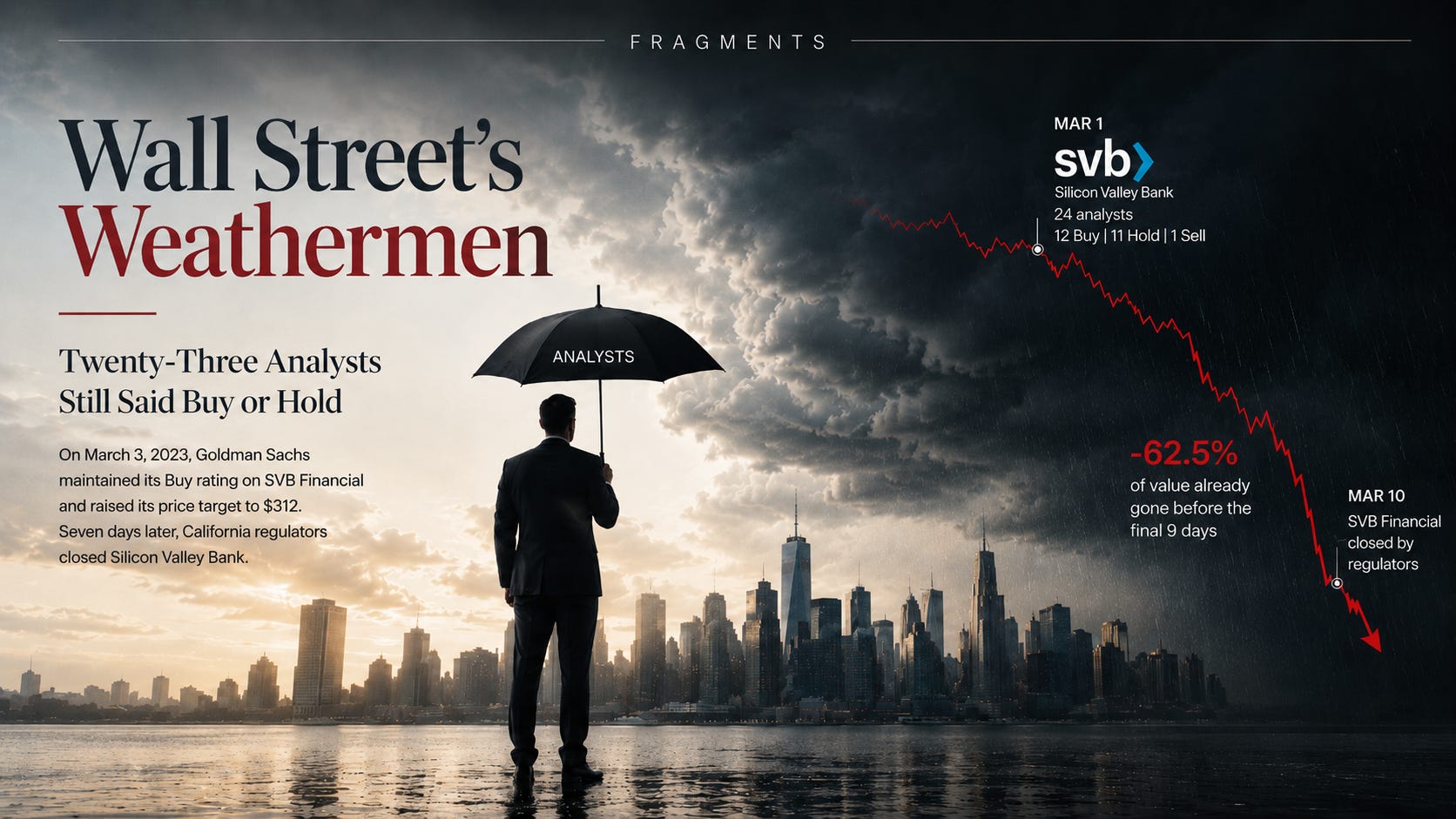
Meteorologists know that the farther out they look, the less certain a forecast becomes. Wall Street can work very differently. An equity analyst can take assumptions about revenue, margins, interest rates, deposits, earnings and valuation, push them twelve months into the future and come back with a number precise to the dollar. On March 3, 2023, Goldman Sachs maintained its Buy rating on SVB Financial Group and increased its price target from $280 to $312. Seven days later, California regulators closed Silicon Valley Bank.
Goldman was hardly alone. On March 1, twenty-four equity analysts covered SVB Financial. Twelve rated the shares Buy, eleven said Hold and only one said Sell. Nine days later there was no operating bank left to analyze. Nobody should expect an analyst to know the exact morning when thousands of depositors will panic simultaneously. A bank run is financial, but it is also human, and once fear starts moving through a connected group of people, events can accelerate much faster than a spreadsheet anticipates.
The timing is harder to dismiss. By March 1, SVB shares had fallen from a roughly $755 closing high in 2021 to $283.03. About 62.5% of the value had already disappeared before those final nine days began. Venture activity had weakened, deposits were declining, interest rates had moved sharply against a large securities portfolio, short interest had been climbing and the losses embedded in that portfolio were visible in the financial statements. Most analysts remained at Buy or Hold.
That gap is the reason for Wall Street’s Weathermen. We care less about whether an analyst eventually changes the forecast than about what has already happened by the time he does. Telling investors to sell only after the stock has already collapsed is a bit like telling someone to go buy an umbrella once it has already started raining. Maybe the umbrella is still useful. The timing leaves something to be desired.
The market was already moving
A stock falling 60% does not tell you that the company will disappear. Markets overreact, businesses recover and ugly situations occasionally become extraordinary investments. SVB’s decline did give us a clock. Something had been changing for more than a year before the final week.
Morgan Stanley began moving away from the consensus. Its analyst went from Overweight to Equal Weight in October 2022 and then to Underweight in December, reducing the target to $186. By March 1, Morgan Stanley represented the only Sell-equivalent recommendation among the twenty-four analysts counted in the regulatory review. He did not predict March 10. He saw enough deterioration to move away months before the bank disappeared.
Short sellers were moving too. Short interest began rising around April 2022, roughly when the unrealized losses on SVB’s securities were becoming increasingly visible. Most sell-side research remained considerably more optimistic. Raymond James continued at Outperform and eventually carried a $375 target. Wells Fargo remained Overweight. Goldman was still at Buy when it moved its target to $312 on March 3. J.P. Morgan remained Overweight and Piper Sandler remained positive.
The analysts were not listening to management announce that the bank was weeks from disappearing. SVB was giving them a recovery story that could be modeled quite comfortably. Management acknowledged weaker venture activity, declining deposits, client cash burn and pressure on net interest income, but expected cash burn to moderate and deposit pressure to ease as 2023 progressed. Modest deposit growth was expected to return during the second half of the year. Higher rates could eventually help as the balance sheet repriced. SVB described itself as having a “high-quality, liquid balance sheet.”
You can see how the twelve-month model gets built from there. Venture funding stays weak for another few quarters. Startups adapt their spending. Deposits eventually stabilize. Older low-yielding securities mature. New assets earn more. Net interest income improves. Conditions look better in 2024.
None of that was impossible. The problem was whether SVB had enough time for it to happen.
At some point, you have to stop looking at the tree and look at the forest. Analysts spend their lives extremely close to companies. They know next quarter’s deposit assumptions, funding costs, net interest margin, loan growth, EPS estimates and every adjustment management makes to guidance. That depth is valuable. Spend enough time with your nose against the screen, though, and the larger picture can become harder to see. You can know almost every leaf on the tree and still lose sight of the forest around it.
The forest at SVB was getting uncomfortable. At the end of 2022, SVB Financial reported approximately $211.8 billion of assets, including $120.1 billion of investment securities and $74.3 billion of loans, funded in large part by $173.1 billion of deposits. More than half of the bank’s assets were sitting in securities. Around 94% of its deposits were uninsured, an extraordinary funding profile for a bank whose customers were concentrated in venture capital, technology and life sciences.
During the technology boom, SVB attracted enormous amounts of cash from venture funds and startups and put a large portion of it into securities, including long-duration bonds purchased when interest rates were much lower. Rates rose sharply and market values fell. Held-to-maturity accounting meant those declines did not have to run through current earnings as long as SVB intended and remained able to hold the securities until maturity. The fair values were still disclosed.
At December 31, SVB carried approximately $91.3 billion of held-to-maturity securities whose fair value was about $76.2 billion. Roughly $15.2 billion separated the two numbers while SVB reported about $16 billion of stockholders’ equity.
That does not mean the bank had already destroyed almost all of its equity. A government-backed bond trading below its original value can keep paying interest and eventually return principal if the owner can hold it long enough. Those last few words were the problem. SVB’s assets needed patience. Its depositors did not have to provide it.
And these were not millions of unrelated retail customers independently deciding what to do with a few thousand dollars. SVB’s customers lived in the same venture ecosystem. They invested together, spoke to the same venture firms, sat on overlapping boards, used many of the same lawyers and advisers and communicated constantly. On the balance sheet, the deposits looked like thousands of separate accounts. In real life, the people controlling the money were much more connected. The structure could work while confidence held. Once confidence started moving in the other direction, thousands of apparently separate decisions could begin behaving like one decision.
An analyst could spend hours debating whether next year’s earnings justified a $280, $312 or $350 target and still miss the question sitting above the entire spreadsheet: what if the bank does not have enough time for any of those forecasts to come true?
We also wanted to know whether the investment operations behind the Wall Street names had reached that conclusion while their research analysts remained positive. Goldman is useful here because its disclosed position had been moving before the failure. By June 30, 2022, Goldman’s 13F reported 118,291 SVB shares. The position rose to 126,651 shares at the end of September and to 176,878 shares at December 31. Goldman had reduced its exposure earlier in the cycle, but its final two quarter-end snapshots of 2022 moved in the other direction.
Goldman later restated its 2022 13F reports in May 2024, correcting the classification and reported value of certain records while leaving their other attributes unchanged. The reports also covered several Goldman entities, so these holdings cannot be treated as the portfolio or opinion of the analyst covering SVB. They tell us something narrower and still useful: Goldman’s disclosed long position was not heading toward zero during the second half of 2022. It increased from June through December. The easy version of the story — Goldman had figured out the disaster, quietly escaped and kept its public research positive — is not supported by the public record.
A large financial institution does not have one brain. Research can reach one conclusion while asset managers, passive portfolios, client accounts, bankers and traders operate under completely different mandates. Investors see one name at the top of a report. Behind it are different people sitting in different rooms with different information.
Paid subscribers continue below
Five days after Goldman raised its SVB target to $312, another part of Goldman was buying the bank’s securities while SVB tried to raise fresh capital. Then more than $40 billion of deposits headed for the exits in a single day.
What happened over the next nine days tells us a lot about what those forecasts were really worth.