
WHO’S NEXT SERIES — Paramount Global
Hidden value in plain sight — price is the headline, control is the decision.

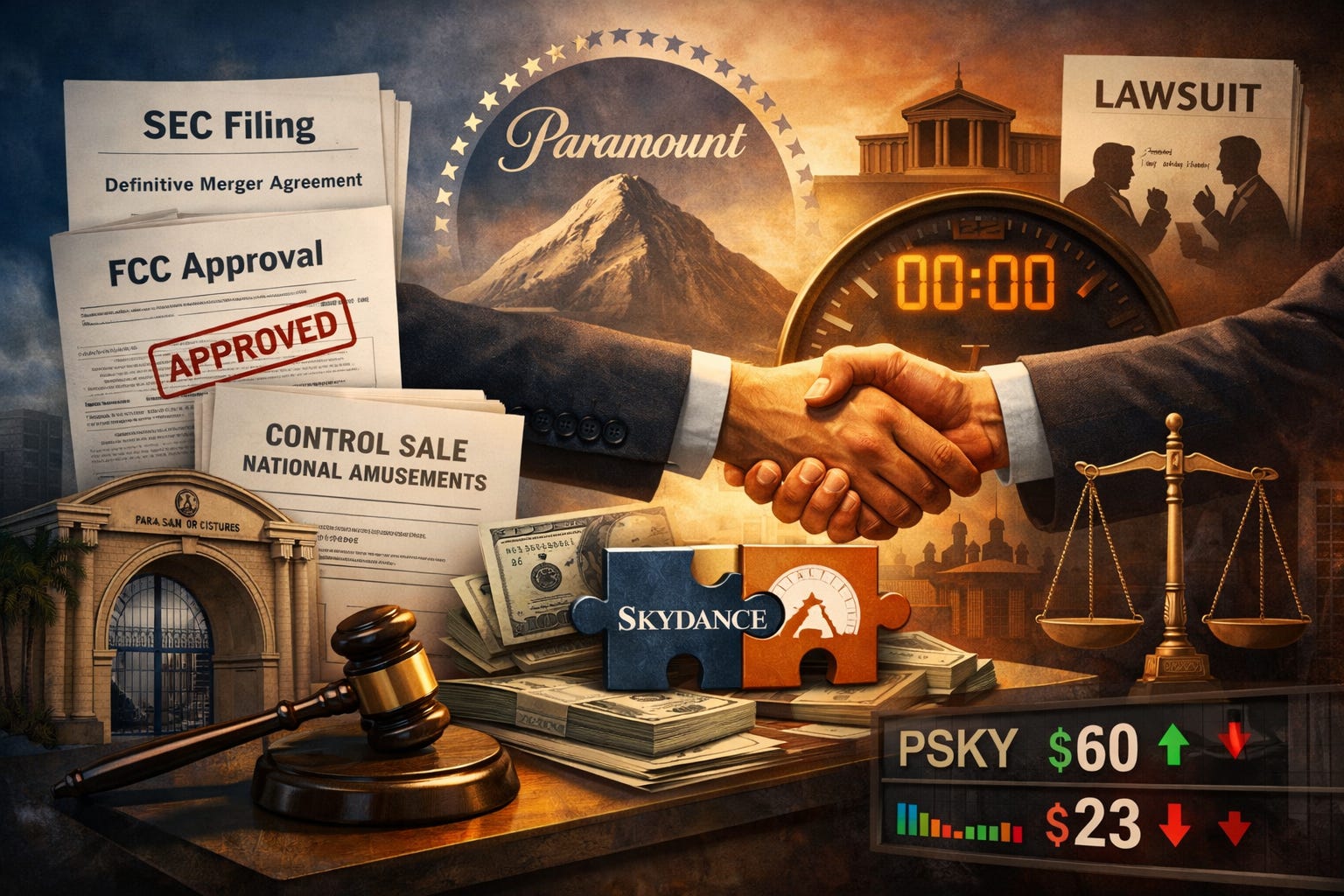
People kept treating Paramount like a normal auction.
It wasn’t.
It was a controlled exit under pressure, inside a regulated box, with a clock that didn’t belong to the market. And a seller that wasn’t “shareholders.”
Paramount didn’t need a prettier story.
It needed an outcome that could close.
The ending already printed: the Skydance–Paramount transaction closed on August 7, 2025 and the new Class B began trading under PSKY. FCC approval landed July 24, 2025. Lawsuit landed right after, with the blunt allegation that the controller got paid at a different level than the public.
So this is not deal gossip.
This is the file on why Paramount was going to be bought and why it refused offers that looked “better” in a headline.
The thing most coverage gets wrong
Most coverage asked one question, over and over:
“Who offered more?”
That’s not the Paramount question.
The Paramount question was:
“Who can buy this in a way the controller can sign, the FCC can grant, the cash can be funded, and the record can survive?”
Because in a controlled company sale, you’re not buying a ticker.
You’re buying a decision.
And the decision sits where control sits.
Timeline
July 7, 2024 — Paramount signs the Skydance deal. Definitive agreement. It includes a 45-day go-shop run through a Special Committee.
Feb 13, 2025 — the SEC filing language is explicit: Paramount and Skydance become wholly-owned subsidiaries of “New Paramount” (renamed “Paramount Skydance Corporation”) at closing.
July 24, 2025 — FCC approval. The FCC’s own description is not “approved the merger.” It’s “granted applications” transferring control / licenses.
August 7, 2025 — deal closes. PSKY begins trading (company release + Reuters).
August 2025 — GAMCO sues, alleging $60 per Class A share for the control layer vs $23 for the public.
That’s the spine.
Now the mechanics.
Deal Anatomy: what actually happened
Here’s the sentence that matters from the SEC paper:
“At the Effective Time, each of Paramount and Skydance will become a wholly-owned subsidiary of New Paramount.”
That’s the whole structure. Everything else is commentary.
The transaction, written like a file
Step 1 — Control gets bought (outside the public float)
Skydance and its partners buy the control vehicle (National Amusements).
This is the “control transfer” leg — the part that decides who can say yes.
Step 2 — The operating companies roll under a new parent
Paramount + Skydance get folded under New Paramount.
That’s the legal reality: one parent, two wholly-owned subs.
Step 3 — Public holders don’t get “one price”
Class B holders had an election (cash or stock), with cash elections subject to proration because the total cash pool was capped.
So the “headline price” is not a single lived experience.
Step 4 — The real approval wasn’t vibes — it was permission
This didn’t close until the FCC granted the required transfers (licenses / authorizations).
That’s why the clock mattered. That’s why engineered-to-clear beats loud.
Step 5 — The inevitable post-close fight
Once the machine closes, the usual controlled-exit dispute shows up: controller economics vs public economics. Reuters reported GAMCO’s claim in blunt numbers.
Between the lines: if you’re still thinking “auction,” you’re reading the wrong genre. This was a control transfer plus a license-transfer gate, wrapped in a record built to survive court.
Translation
What the market thought it was:
A bidding war. Who pays more. Who wins the headline.
What it actually was:
A control transfer that had to clear licenses, survive a regulator, and leave a defensible paper trail.
Why offers were refused:
Because some offers were louder but not sellable.
Different product. Different clock. Different risk.
What decided the outcome:
Not the number.
The mechanism.
How to read the result:
If you’re still comparing premiums, you missed the file.
If you’re reading structure, timing, and who can sign — you’re in the right room.
Everything below is the full WHO’S NEXT file on Paramount.
Why the deal was inevitable.
Why certain offers were refused.
How the FCC gate reshaped the outcome.
Why this wasn’t one price — but two.If the short version is enough, stop here.
If you want the mechanism, keep going.